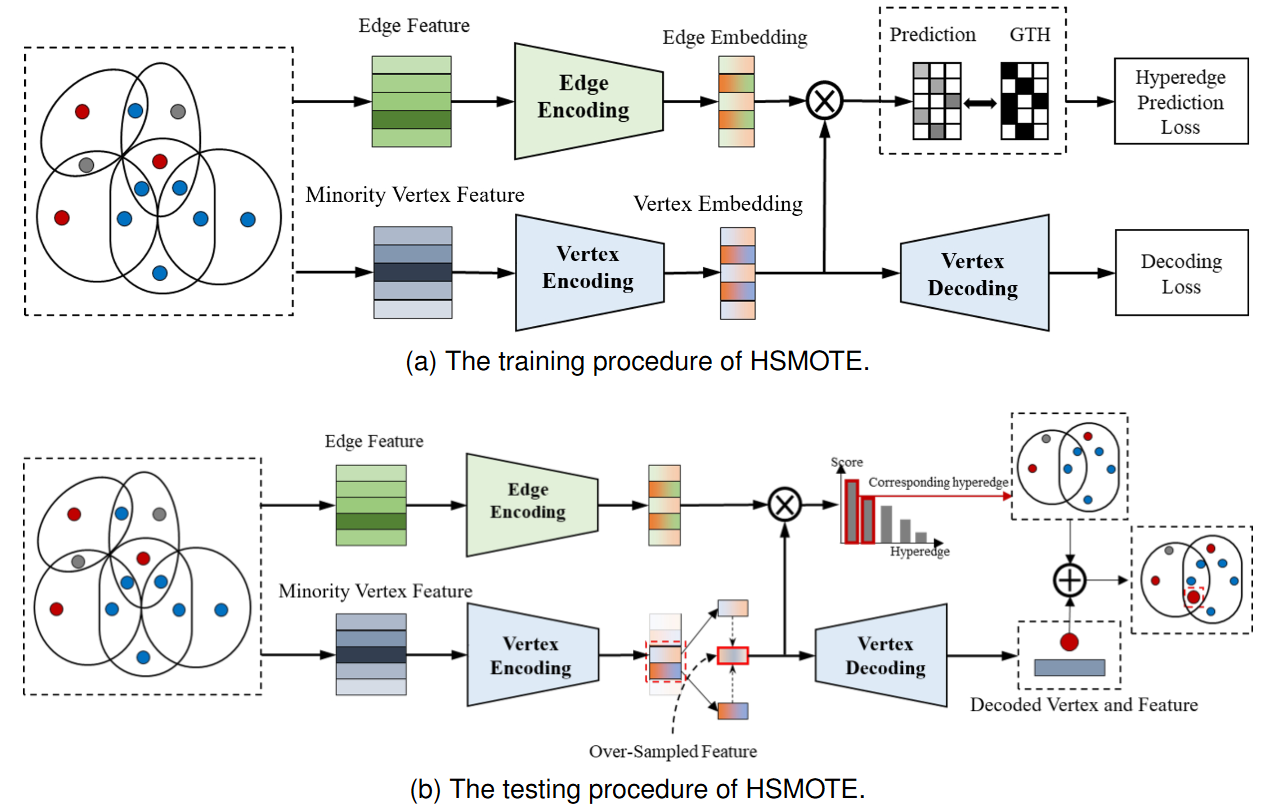
High-order correlations, which capture complex interactions among multiple entities, extend beyond traditional graph representations and support a wider range of applications. However, existing neural network models for high-order correlations encounter scalability issues on large datasets due to the substantial computational complexity involved in processing large-scale structures. In addition, long-tailed distributions, which are common in real-world data, result in underrepresented categories and hinder the model’s ability to learn effective high-order interaction patterns for rare instances. To address these issues, we introduce a novel framework known as HyperGraph-based High-order Correlation analysis (HGHC) for large-scale long-tailed data classification. Firstly, to tackle the long-tailed distribution problem, HGHC generates synthetic vertices and computes their attributed high-order correlations using an oversampling module inspired by SMOTE, termed HSMOTE, to enhance the representation of tail categories. Secondly, for efficient computational scaling, we treat the data as having two modalities: the structural modality capturing high-order relationships and the feature modality representing individual attributes. We perform computations on both CPU and GPU separately and then fuse the results to achieve a lightweight vertex transformation and aggregation scheme for high-order correlation data. Additionally, we contribute the first benchmark for large-scale long-tailed datasets involving high-order correlations, known as Amazon-LT, which includes multiple datasets with varying imbalance ratios. Our experimental results demonstrate that HGHC achieves state-of-the-art performance in handling high-order correlation analysis issues for large-scale, long-tailed data.
@article{han_2026_hghc,title={Hypergraph-Based High-Order Correlation Analysis for Large-Scale Long-Tailed Data Classification},author={Han, Xiangmin and Zhang, Yubo and Ying, Shihui and Gao, Yue},journal={IEEE Transactions on Pattern Analysis and Machine Intelligence},year={2026},month=jan,volume={48},number={1},pages={270--282},publisher={IEEE},doi={10.1109/TPAMI.2025.3603631},}
IEEE TPAMI, IF 20.8
Inter-intra hypergraph computation for survival prediction on whole slide images
Xiangmin Han, Huijian Zhou, Zhiqiang Tian, Shaoyi Du, and Yue Gao*
IEEE Transactions on Pattern Analysis and Machine Intelligence, Jul 2025
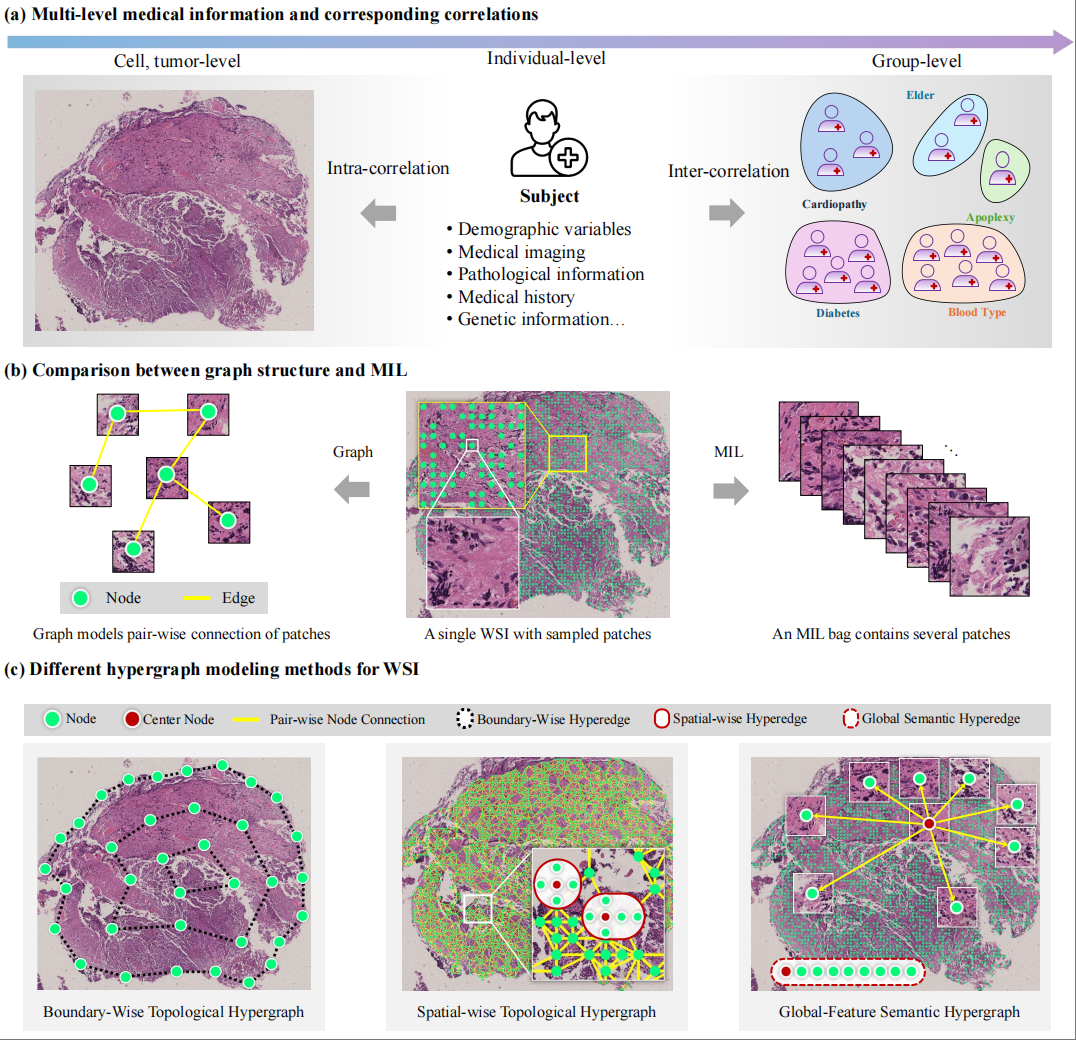
Survival prediction on histopathology whole slide images (WSIs) involves the analysis of multi-level complex correlations, such as inter-correlations among patients and intra-correlations within gigapixel histopathology images. However, the current graph-based methods for WSI analysis mainly focus on the exploration of pairwise correlations, resulting in the loss of high-order correlations. Hypergraph-based methods can handle such high-order correlations, while existing hypergraph-based methods fail to integrate multi-level high-order correlations into a unified framework, which limits the representation capability of WSIs. In this work, we propose an inter-intra hypergraph computation (I^2HGC) framework to address this issue. The I^2HGC framework implements multi-level hypergraph computation for survival prediction on WSIs, namely intra-hypergraph computation and inter-hypergraph computation. Specifically, the intra-hypergraph computation considers each patch sampled from the histopathology WSI as a vertex of the intra-hypergraph and models the high-order correlations among all patches of an individual WSI in both topology and semantic feature spaces using a hypergraph structure. Then, the intra-hypergraph module generates the intra-embedding and intra-risk for each patient. Subsequently, the inter-hypergraph computation employs these intra-embeddings as features for each patient to form the population-level high-order correlations using data- and knowledge-driven hypergraph modeling strategies. Finally, the intra-risks and the inter-risks are fused for the final survival prediction of each patient. Extensive experimental results on four widely used TCGA carcinoma datasets are presented. We demonstrate that the hypergraph structure captures significantly richer correlations than the graph structure, encompassing all pairwise correlations as well as higher-order interactions through hyperedges. For WSIs with a vast number of pixels and complex correlations, hypergraph-based methods effectively capture topological and semantic information while mitigating the exponential growth of pairwise edges, offering practical advantages for large-scale medical image analysis.
@article{han_2025_inter,title={Inter-intra hypergraph computation for survival prediction on whole slide images},author={Han, Xiangmin and Zhou, Huijian and Tian, Zhiqiang and Du, Shaoyi and Gao, Yue},journal={IEEE Transactions on Pattern Analysis and Machine Intelligence},year={2025},month=jul,volume={47},number={7},pages={6006--6021},publisher={IEEE},doi={10.1109/TPAMI.2025.3557391},}
IEEE TNNLS, IF 10.2
Hypergraph Foundation Model for Brain Disease Diagnosis
Xiangmin Han, Rundong Xue, Jingxi Feng, Yifan Feng, Shaoyi Du, Jun Shi*, and Yue Gao*
IEEE Transactions on Neural Networks and Learning Systems, Oct 2025
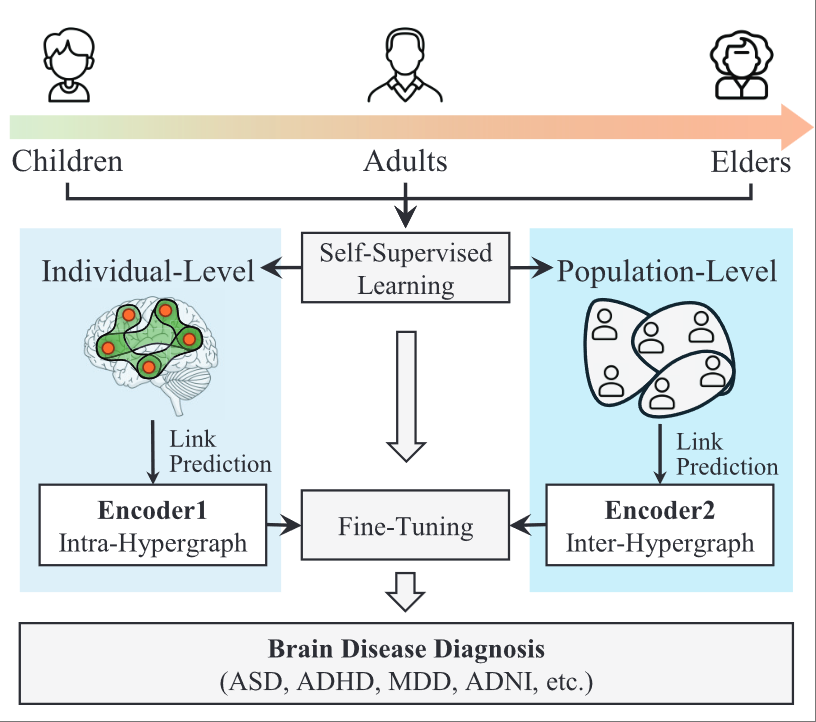
The goal of the hypergraph foundation model (HGFM) is to learn an encoder based on the hypergraph computational paradigm through self-supervised pretraining on high-order correlation structures, enabling the encoder to rapidly adapt to various downstream tasks in scenarios, where no labeled data or only a small amount of labeled data are available. The initial exploratory work has been applied to brain disease diagnosis tasks. However, existing methods primarily rely on graph-based approaches to learn low-order correlation patterns between brain regions in brain networks, neglecting the modeling and learning of complex correlations between different brain diseases and patients. This article proposes an HGFM for brain disease diagnosis, which conducts multidimensional pretraining tasks to explore latent cross-dimensional high-order correlation patterns on various brain disease datasets. HGFM is a high-order correlation-driven foundation model for brain disease diagnosis and effectively improves prediction performance. Specifically, HGFM first performs brain functional network link prediction tasks on individual brain networks and group interaction network link prediction tasks on group brain networks, constructing an HGFM for brain disease diagnosis. In downstream tasks, it achieves predictions for different brain disease diagnosis tasks through few-shot learning fine-tuning methods. The proposed method is evaluated on functional magnetic resonance imaging (fMRI) data from 4409 patients across four brain diseases. Results show that it outperforms existing state-of-the-art methods in all brain disease diagnosis tasks, demonstrating its potential value in clinical applications.
@article{han_2025_hypergraph,title={Hypergraph Foundation Model for Brain Disease Diagnosis},author={Han, Xiangmin and Xue, Rundong and Feng, Jingxi and Feng, Yifan and Du, Shaoyi and Shi, Jun and Gao, Yue},journal={IEEE Transactions on Neural Networks and Learning Systems},year={2025},month=oct,volume={36},number={10},pages={17702--17716},publisher={IEEE},doi={10.1109/TNNLS.2025.3554755},}
Engineering, IF 12.8
Hypergraph computation
Yue Gao*, Shuyi Ji, Xiangmin Han, and Qionghai Dai
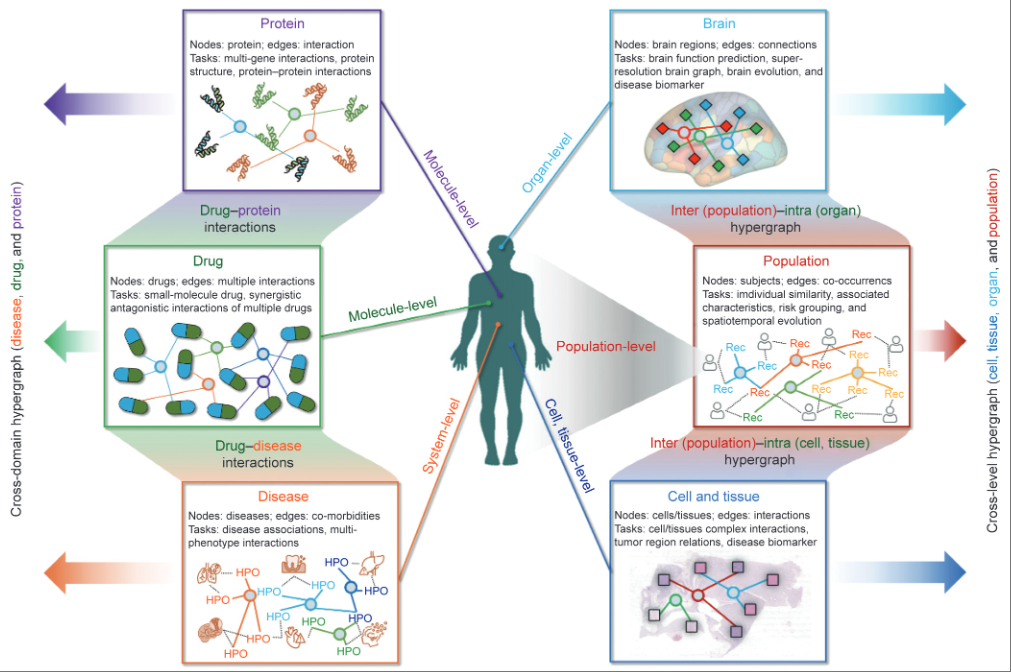
Practical real-world scenarios such as the Internet, social networks, and biological networks present the challenges of data scarcity and complex correlations, which limit the applications of artificial intelligence. The graph structure is a typical tool used to formulate such correlations, it is incapable of modeling high-order correlations among different objects in systems; thus, the graph structure cannot fully convey the intricate correlations among objects. Confronted with the aforementioned two challenges, hypergraph computation models high-order correlations among data, knowledge, and rules through hyperedges and leverages these high-order correlations to enhance the data. Additionally, hypergraph computation achieves collaborative computation using data and high-order correlations, thereby offering greater modeling flexibility. In particular, we introduce three types of hypergraph computation methods: ① hypergraph structure modeling, ② hypergraph semantic computing, and ③ efficient hypergraph computing. We then specify how to adopt hypergraph computation in practice by focusing on specific tasks such as three-dimensional (3D) object recognition, revealing that hypergraph computation can reduce the data requirement by 80% while achieving comparable performance or improve the performance by 52% given the same data, compared with a traditional data-based method. A comprehensive overview of the applications of hypergraph computation in diverse domains, such as intelligent medicine and computer vision, is also provided. Finally, we introduce an open-source deep learning library, DeepHypergraph (DHG), which can serve as a tool for the practical usage of hypergraph computation.
@article{gao_2024_hypergraph,title={Hypergraph computation},author={Gao, Yue and Ji, Shuyi and Han, Xiangmin and Dai, Qionghai},journal={Engineering},year={2024},volume={40},pages={188--201},doi={10.1016/j.eng.2024.04.017},}

 Hypergraph-Based High-Order Correlation Analysis for Large-Scale Long-Tailed Data Classification